
Educational institution management structure
Management unit
School management is carried out through the implementation of managerial (technological) functions, which include planning, organization, coordination, control, regulation (correction), accounting, and analysis.
Indicators of educational process management:
- level of management of the process of creating appropriate educational and material, educational and methodological, sanitary and hygienic conditions for the education and upbringing of schoolchildren;
- organizational work on staffing classes;
- level of management activities to provide children and adolescents with quality secondary education;
- management of creating conditions for variability in learning;
- level of management of work to increase the efficiency and effectiveness of educational work, increase students' interest in learning;
- level of management of work with gifted children;
- educational work management;
- level of management of work on the physical development of schoolchildren;
- quality of documentation of educational work;
- level of analysis of the effectiveness of the educational process in dynamics.
Intra-school management is based on the use of a system of local monitoring of an educational institution. It ensures broad inclusion in the process of preparation and adoption of management decisions of all subjects of the educational process, as well as improvement of school management technology. This is also facilitated by the use of indicators of target functions of educational institution management.
All management activities are based on the principles of personal orientation. Management of the complex social structure, which is a modern school, is carried out through the participation of parents, students, broad segments of society, collegial management bodies: school council, pedagogical council, general meeting of the labor collective, parent meetings, student self-government. It is state-public management that ensures the transition of the school from the mode of functioning to the mode of development.
School management is carried out through a combination of different forms of management.
Pedagogical Council - This is a collegial school management body, whose powers are determined by the Regulations on a general education institution. Its main tasks are to:
- combining the efforts of teachers and leaders in solving problems of the educational process, improving the quality of teaching and education of students;
- determining the goals and prospects of the teaching staff's activities;
- assisting the administration in implementing the achievements of psychological and pedagogical science, innovations and best practices in teaching and educating students into the work of teachers.
The pedagogical council has the right:
- listen to the school principal's report on the state of the educational process;
- to study individual aspects of the mass educational process on the initiative and support of the majority of members of the pedagogical council;
- to express distrust in leaders;
- to make proposals for early certification of individual teachers, assignment of ranks or deprivation of them in the event that the quality of the teacher's work does not correspond to the rank received;
- to cancel previously made decisions, having ascertained their untimeliness, illegality, and unfoundedness;
- provide specific assistance to individual teachers in organizing the educational process.
The head of the pedagogical council is the school director.
Parents' Committee is a voluntary public formation of parents of school students, created on the basis of the unity of interests of parents regarding the implementation of the rights and obligations of their children during their studies at school. It was created to protect the interests of students in the school's public self-government bodies, in the relevant state and judicial bodies, as well as to assist the teaching staff in implementing the tasks of general secondary education, working together with the teaching staff to develop students' active life positions, creative abilities and initiative, increase their level of education and achieve the mandatory level of basic training.
The main goal of the class parent committee is to create conditions for the formation of a student team and the favorable development of each student in it. It is the executive body of the parent meeting of a separate class. Its main areas of activity are:
- creating a data bank of parent resources;
- organization of joint activities of parents and children;
- disseminating best practices in family and family education;
- creating and preserving the traditions of child-adult society.
The administration of an educational institution considers the process of school management as a process that is reduced to the consistent performance of its functions: pedagogical analysis, setting goals and objectives based on this analysis, planning, organization, control, regulation, and making management decisions. This is complex and intense work with teaching, student, and parent teams. A correctly made management decision contributes to the orderliness of each subsystem. Intra-school control is the main source of school management.
Pupil self-government
- a method of organizing a children's team, which ensures the formation of relationships of responsible dependence in the team and organizational traits of an individual;
- an integral part of the institution's system, as it solves specific tasks in creating a unified team of adults and children;
- consequence of pedagogical management of children by adults;
- the principle of organizing the life of a children's group;
- activities carried out by the children themselves, including goal setting, its development and aimed at improving the team and each individual in particular.
Educational institution management structure
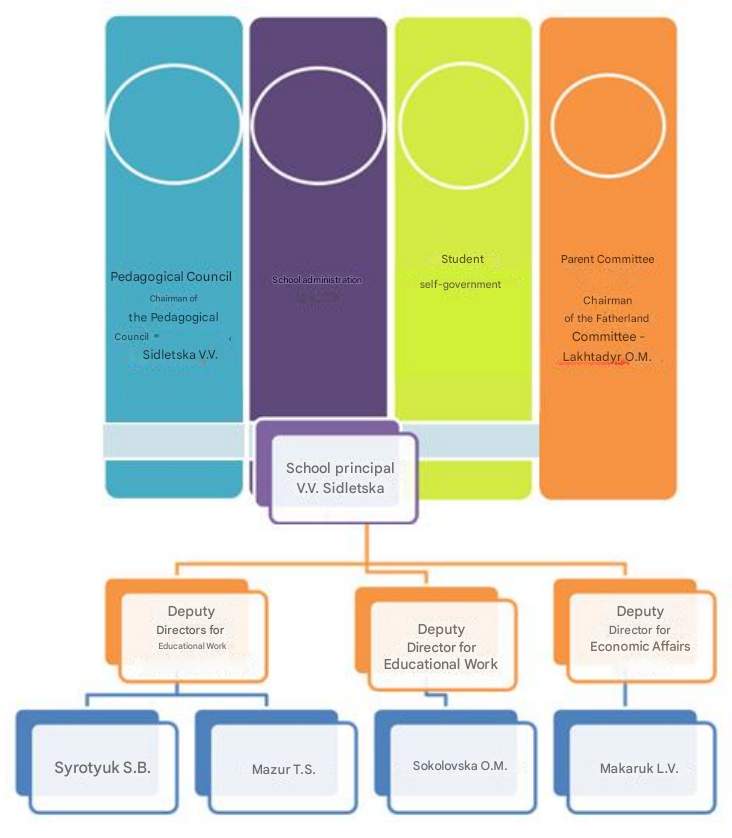
The main principles of management are the development and improvement of collective forms of leadership, the active inclusion of teachers, students, parents, the public in the management process, the formation of new economic relations between the educational institution and other institutions. To solve the problems of the student body, there is a council of youth and children's associations. Parents participate in the activities of the institution through parent committees of all levels, which act within the limits of their powers on the basis of the School Charter.
The director coordinates the activities of all advisory structures. Management is carried out by combining collegiality and individual management. Direct management is carried out by the school director, who is appointed by the education department of the executive committee of the city council in agreement with the founder.
A permanent advisory collegial body is being created at Starokostyantynivska Secondary School of grades I-III No. 1 - the School's Pedagogical Council.
ICT is also widely used in management activities. Namely:
- maintaining and processing internal school documentation;
- drawing up lesson schedules, printing an operational schedule for students and teachers when changes are made to the schedule due to the absence of teachers using the АSС.TimeTables program;
- creation and use of a database of teachers and students at the school;
- monitoring of teacher activities;
- searching and gathering information using the Internet;
- using email to communicate with education authorities;
- establishing creative connections with other educational institutions;
- testing of school staff and students;
- informing parents and pupils through school website https://starcon-znz1.school.social/en/ and social network Facebook.com.
Meetings of the Methodological Council and the Pedagogical Council of the school are held using multimedia technology. The coverage of important issues of the meetings is demonstrated on slides in the form of tables, graphs, and comparative diagrams.
The use of innovations in the system of preparation and holding of the pedagogical council is being introduced. The introduction of the latest technologies makes it possible to solve problematic issues democratically - as a result of joint discussion, making collective decisions, and all this through the experience, achievements of the team, and not through the intrusive vision of the directorate. Work in small groups, the use of various forms of discussions, "Brainstorming", situational modeling and other innovations, both in preparation for the pedagogical council and during the meeting, makes it possible to involve all teachers in active creative activity; coordination of the opinions of the team, based on their own research, testing, and developments; develops a democratic style of communication.